Collective Mechanical Intelligence
How does intelligence emerge from collectives and mechanical interactions?
From insect swarms to fish schools
From physics and biology to biomimetic robotics
KOLab examines the mechanics of complex and collective systems
“A whole greater than the sum of its parts”
Remarkable examples of collective behavior in nature


How do they accomplish this?
How can robots swarm organize like them?
Welcome!
We are the Kollective Organization Lab, aka KOLab, at the Mechanical Engineering Department at Tufts University near Boston, USA. We are very excited to have you here!!
On this website, you can find our current and past research projects and some other things we’ve done just for fun. I hope you will find them interesting!
We at KOLab are fascinated by:

- Mechanics: Force is the most tangible and impactful thing that drives all natural and artificial systems. But it can also be the most invisible, mediated by the tiniest movement of the environment. How can we reveal the vortices, flow, and sound generated by animals and robots? How are these external stimuli transported and diffused? How do they provide force or information for individuals to self-organize?
- Complex Systems: Animals and robots are complex and intelligent in that the output (their locomotion) is not a simple linear function of their input (what they sense and how they contract their muscles). Their movement arises from the complex interaction between internal processing (neural or non-neural) and external environments (physical or social). How can we model and engineer these systems?
- Collective Behavior: Complexity and intelligence often originate from collective behavior (high dimensions). It is with collectives of “neurons” that allow us and AI models to think and generate complex responses. It is with collectives that allow animal groups and human societies to form wholes greater than the sum of their parts. How do these collective behavior emerge from interactions among individuals?
Specifically, our recent focus has been on the hydrodynamic interaction in fish schools and underwater robots, where we ask (and try to answer!) how underwater swimmers affect each other hydrodynamically and how flow and acoustic information can be be used for self-organization.
We use a combination of biomimetic robotics, animal experiments, and numerical simulations to reveal new insights. We build fish-like robots to recreate how fish interact with each other and self-organize in water; we work with biologist to film and track fish schools under different conditions; we make sense of our experimental results and provide further predictions using agent-based models and other numerical techniques.
Beyond our core research mission, KOLab has a very broad interest! We are always cooking some curiosity-driven projects in the background, using our diverse research skills. We have published on the physics of tossing wok and examined the effect of lane changing in highway traffic. We also care deeply about social justice, constantly educating ourselves and doing small but mighty things to change the world!
“It is in collectivities that we find
reservoirs of hope and optimism.”

Angela Davis
Freedom is a constant struggle
October 2026
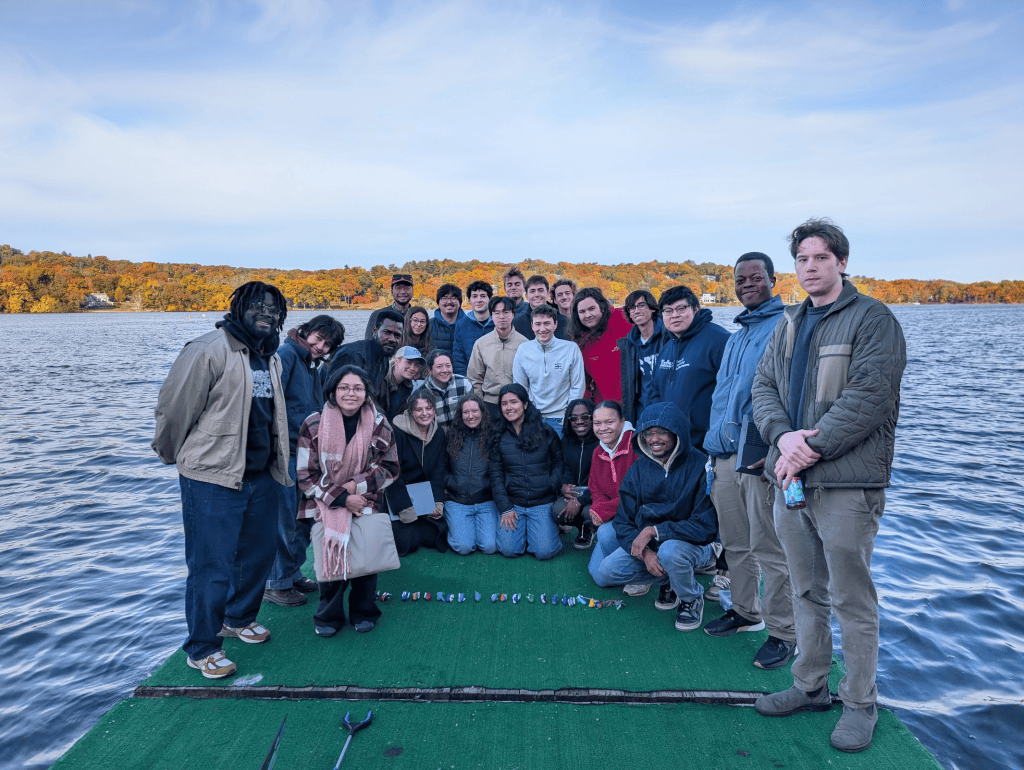
KOLab took the Robotics class to the Mystic Lake, MA to test their robots! It was a huge success and we had 17 untethered fish robots doing figure eights in the wild!
October 2026
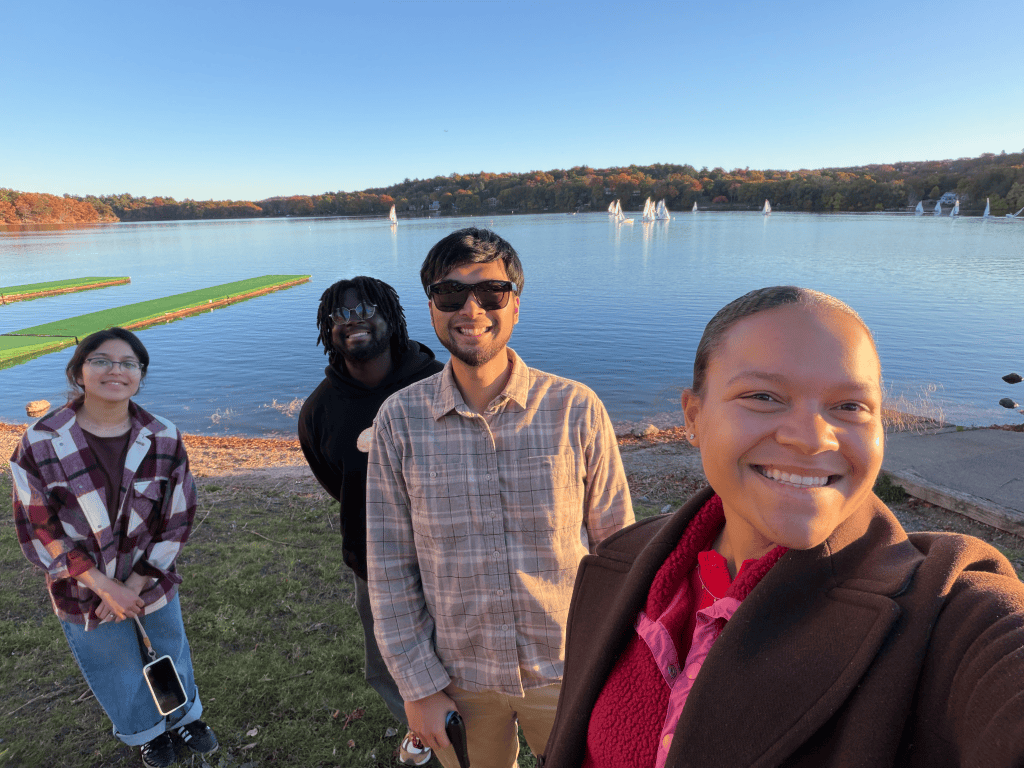
Meet the core KOLab members in fall 2026! We came from different places but share the same passion and love 🐟.
June 2026
Hungtang presented at the Mathematics and Biology Symposium at Harvard Center of Mathematical Sciences & Applications and the Biology Seminar at UMass Boston

June 2026
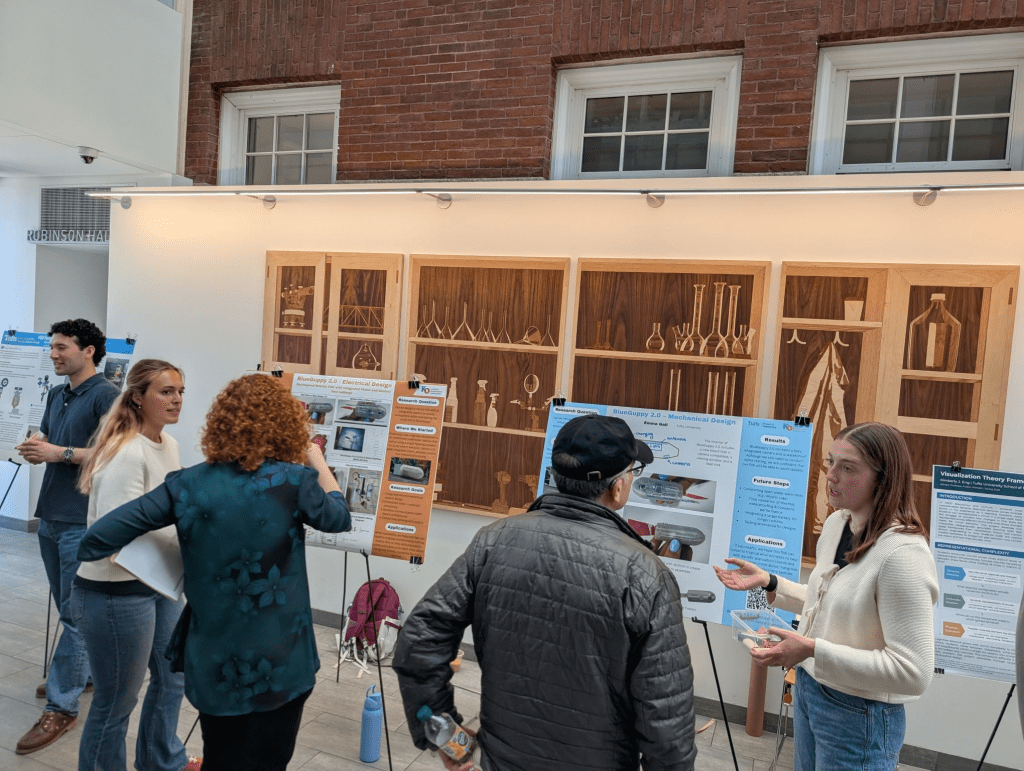
Emma and Ceci impressed everybody with their poster summarizing their semester-long development of a new fish robot!
August 2025
BlueGuppy is finally introduced to the world! This first paper describes its hydrodynamics and its ability to turn using its only actuator — a biomimetic tail!

July 2025
Hungtang’s paper tracking fish schools in 3D for ten hours is out in Scientific Reports! Excited to reveal a new formation, we call ladder formation, that has never been found before!

Feburary 2025
Hungtang just signed an offer with the Tufts University! Extremely excited to continue my research journey there. The Kollective Organization lab at Tufts will start in Jan. 2026.

August 2024
Had a lot of fun at Friday Harbor Lab! Hungtang spent a whole month at the field site learning everything about fish. I will miss all the friends there.

May 2024
It’s such an honor to win the “Exemplar Mentor Award” from Princeton University. Thank you, Brian!

January 2024
A very snowy winter at Princeton! A photo of all the grad students and postdocs at the Nagpal Lab

January 2024
Went to Seattle to attend SICB (Society of Integrative and Comparative Biology). It was the first time presenting BlueGuppy at a conference!
November 2023
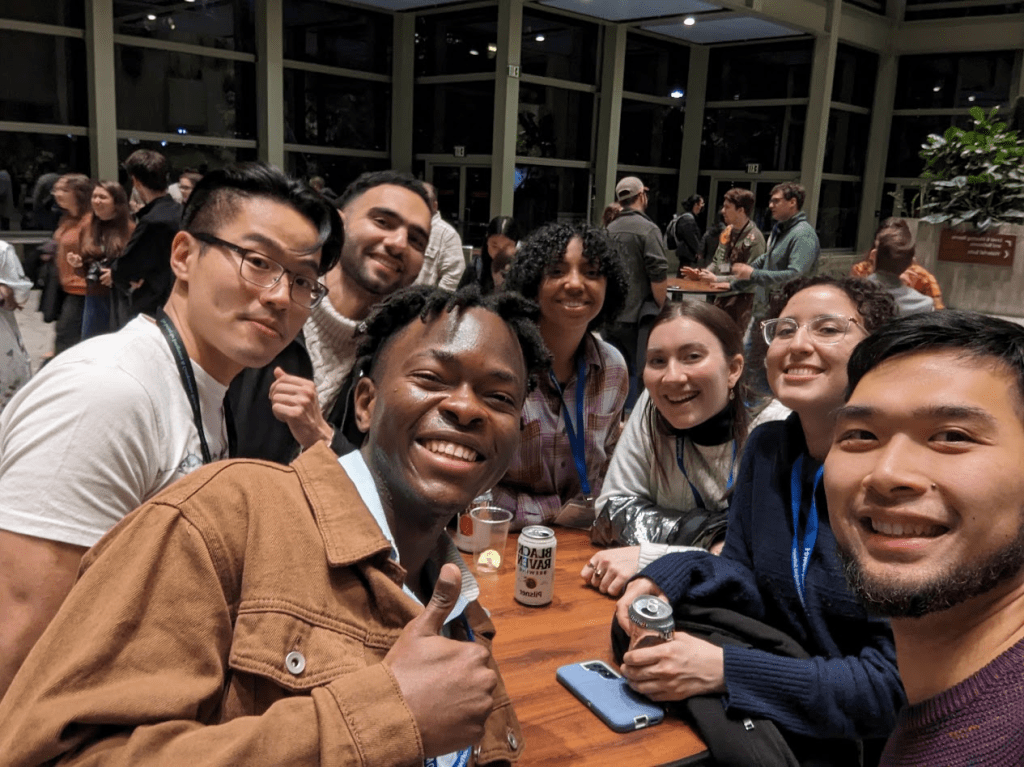
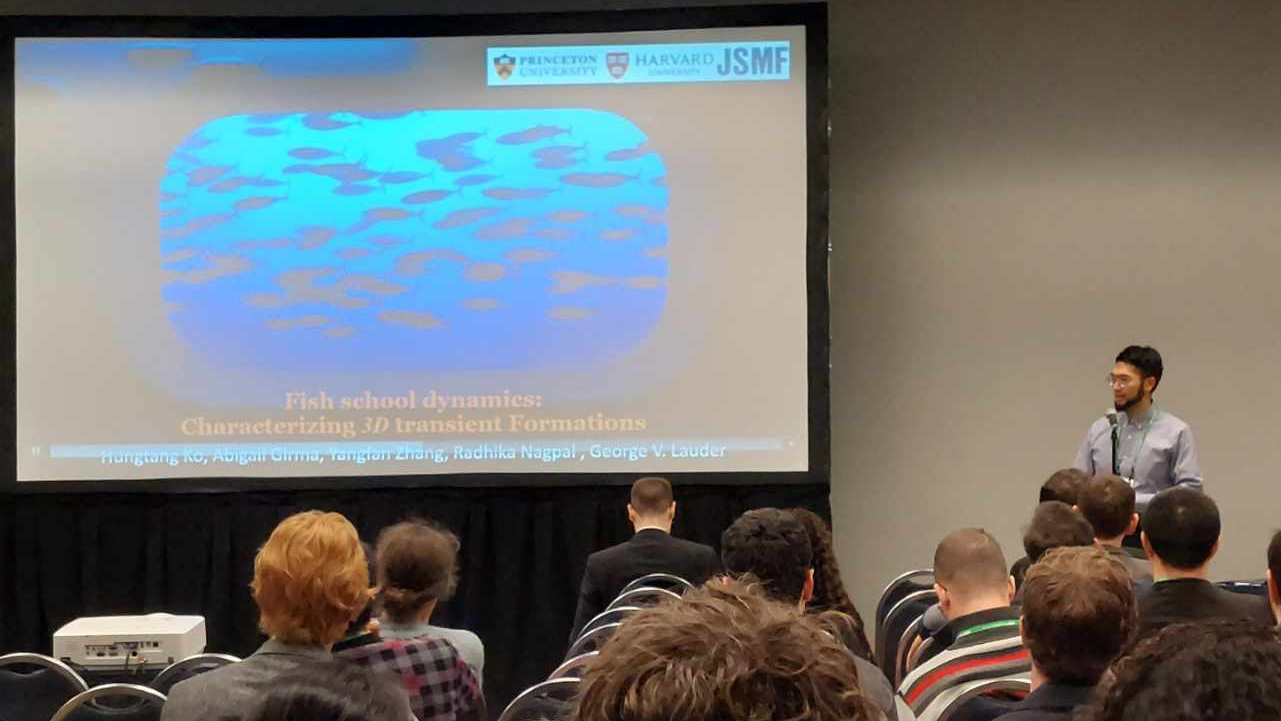
Hungtang presented research updates on tracking 3D formations of fish schools at the national fluid conference DFD!
October 2023
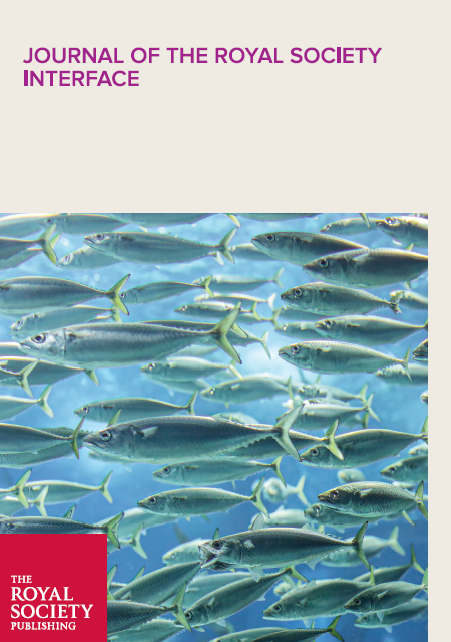
Hungtang published a perspective at Royal Society Interface, one of his favorite interdisciplinary journals.