
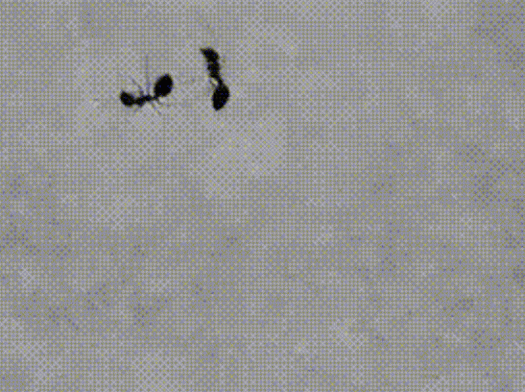
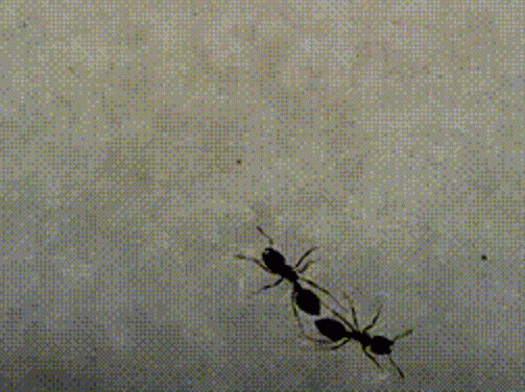
Fire ants are experts in making rafts to survive floods. It would make sense to expect them to excel at finding neighboring ants on the water surface. However, when we put a pair of fire ants on the water surface over and over again, we find that they never connect and form rafts!
when fire ants are close to each other, they kick others out of the way through their random motion. It seems that the pheromone signal that they use to communicate doesn’t work as effectively on the water surface and that they are oblivious to each other. The random kicking of fire ants prevents the formation of rafts.
On the other hand, we observe ants attracting to each other through the surface tension force! This is the same mechanism that attracts Cheerios together, hence called the Cheerios effect.
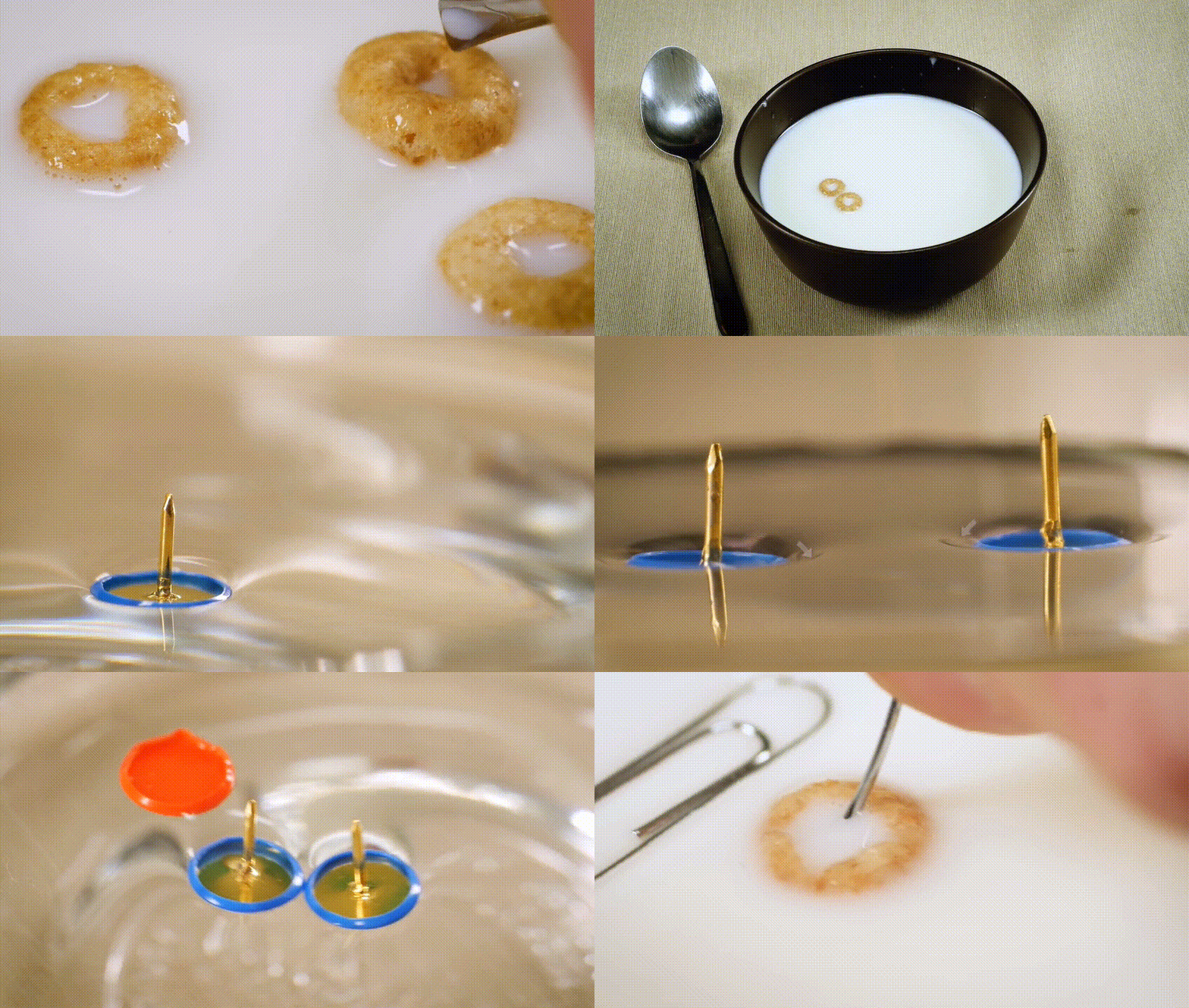
Fire ants are just randomly moving Cheerios!
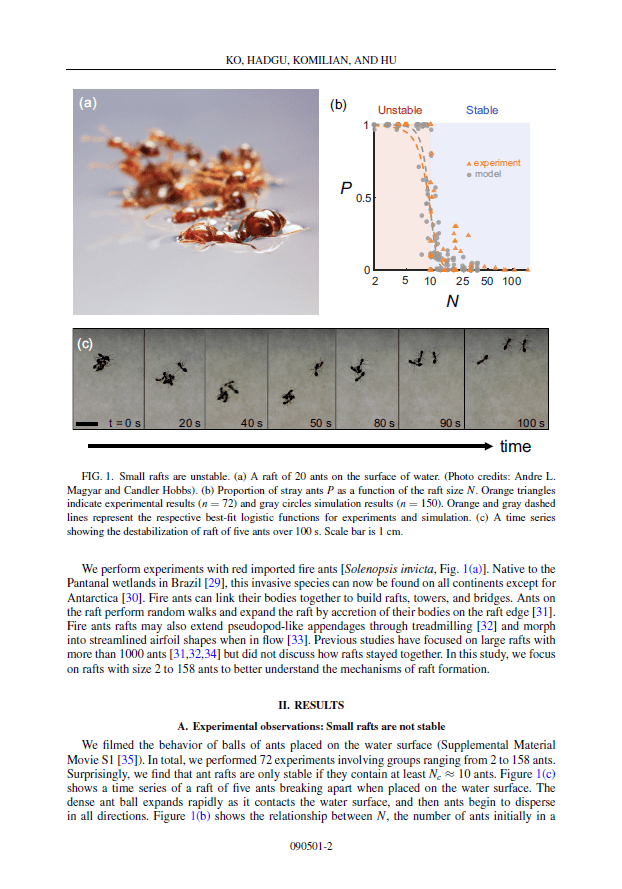
Modeling fire ants as randomly moving Cheerios, we are able to recover our other surprising observation that small fire ant rafts are unstable. Both our experiments and models point to the fact that fire ant rafts need to be a certain size to remain stable. That magical critical number for fire ants is ten. But it can be a different value for different insects. Biologists don’t have a systematic survey on what insect species can form rafts, and what can’t. Our results suggest that there could be more rafting species than previously thought!

Ko, H., Hadgu, M., Komilian, K. and Hu, D.L., 2022. Small fire ant rafts are unstable. Physical Review Fluids, 7(9), p.090501.
 KOLab @ Tufts