
Fish school biomechanics & biomimetic robots

Designs and coordination strategies of fish-like robots
One research method that I use for understanding fish school dynamics is robotics. This is particularly powerful for understanding the hydrodynamics of fish. It is very hard to measure the fluid field around living fish! But a fish-like robot will generate exactly the same flow as a fish. Fish-like robot swarms will allow us to learn how fish interact with each other hydrodynamically, and what sensory information they get from flow. Building these swarms will also allow us to monitor aquatic ecosystem in the wild without disturbing them as much as propeller based underwater vehicle would.

- Ko, H., Saro-Cortes, V., Sedky, G., Mmari, B., Ni, D., Wissa, A., Nagpal, R., 2025. BlueGuppy: tunable kinematics enables maneuverability in a minimalist fish-like robot. Bioinspiration & Biomimetics, 20(5), p.056006.
- Saro-Cortes, V., Sedky, G., Ko, H., Flammang, B., Wissa, A., 2023. Hydrodynamic Evaluation of a Flying Fish Robotic Model Organism: A Study on the Effects of the Caudal Fin Shape. 2023 IEEE Conference on Control Technology and Applications (CCTA), pp. 670-674.
- Ni, D., Ko, H., Nagpal, R., 2024. Leader-Follower 3D Formation for Underwater Robots. Distributed Autonomous Robotic Systems: 17th International Symposium. Springer International Publishing
Collective behaviors of fish schools
Fish schools are so mesmerizing! It has attracted a lot of research over the past century, but a lot of questions remain — many can only be answered using an interdisciplinary approach. I spent a lot of time reading the biology, fluid mechanics, and robotics of fish schools. In an article, I proposed a new perspective and summarized the exciting questions that future research will answer.
These questions include: What formations do fish like in 3D? How are fish schools affected by their fluid environment? How do they affect the fluid environment? We pursue these questions using organismal experiments and techniques such as computer vision (neural network!) and respirometry (to measure metabolism).

- Ko H., Lauder G. V., Nagpal R., 2023, The role of hydrodynamics in collective motions of fish schools and bioinspired underwater robots. Journal of the Royal Society Interface (Cover), 20: 20230357
- Ko, H., Girma, A., Zhang, Y., Pan, Y., Lauder, G. V. & Nagpal, R., 2025, Beyond planar: fish schools adopt ladder formations in 3D. Scientific Report 15, 20249.
- Zhang, Y., Ko, H., Calicchia, M. A., Ni, R., Lauder, G. V., 2024, Collective movement of schooling fish reduces the costs of locomotion in turbulent conditions. PLoS biology, 22(6), e3002501.
Swimming kinematics of a dead fish
It is widely known that dead fish don’t swim, but do they really? Researchers almost a decade ago found that a dead fish would vibrate with the flow if you put them behind a pillar. It was hypothesized that this was to because their flexible bodies synchronized with the alternating flow behind a cylinder. While drawing a lot of interest, the experiment was proven difficult to repeat.
That was until the summer of 2024, when I attempted the same experiments with two intertidal fish species, who can be found swimming behind bull kelps (super long stems!) and pillars under docks. I discover that it is indeed challenging to repeat the experiment as is. But with some modification, the experiment can be repeated and quantified as a function of various experimental conditions. Stay tuned to learn what I found!

- Ko, H., Vandenberg, M. L., Hawkins, O., Summers, A., Nagpal, R., Donatelli, C., Vibrating with flow: flexible bodies of dead fish enable passive undulation behind obstacles (Conference Presentation at SICB 2025; Manuscript in Submission)
Springtail biomechanics
Springtails are these super cool animals with six legs (They are hexapods but not insects). They are everywhere, from soil, to snow, to … above the water surface? They are typically very small so that it’s hard to notice that they are around. They are known to have this special appendage at their back, called furcula. It basically serves as a spring-loaded upside-down catapult that shoots themselves up when predators strike. My collaborators and I have been looking at the biomechanics of their jumps. We have published previously focusing on how they jump and land on water. Currently, we are working on comparing the jumping performance of springtails with different body proportions.
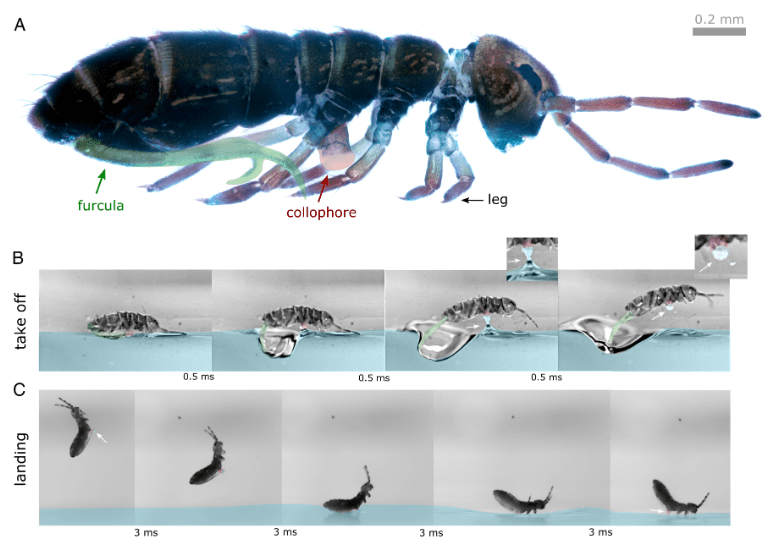
- Ortega-Jimenez, V. M., Challita, E.*, Kim, B.*, Ko, H.*, Gwon, M., Koh, J-S., Bhamla, M.S., Directional takeoff, aerial righting, and adhesion landing of semiaquatic springtails. Proceedings of the National Academy of Sciences 119 (46), e2211283119
- Harrison, J., Smith, A., Ko, H., Kim, B., Koh, J., Bhamla, S., Controlling ultrafast jumps: how furca morphology affects jump dynamics in springtails and robots. (Conference Presentation at SICB 2024 & DFD 2023; Manuscript in Preparation)
Insect collective behavior in air and water
Raft Formation & Stability
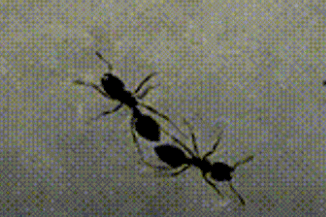
Fire ants are known to create gigantic rafts using their bodies to survive flooding seasons in their native habitat, Amazon forest. They retain this behavior even if they are now found very far away from their native habitat. They were everywhere in Atlanta where I did my PhD. I have also found them in Taipei, next to my home.
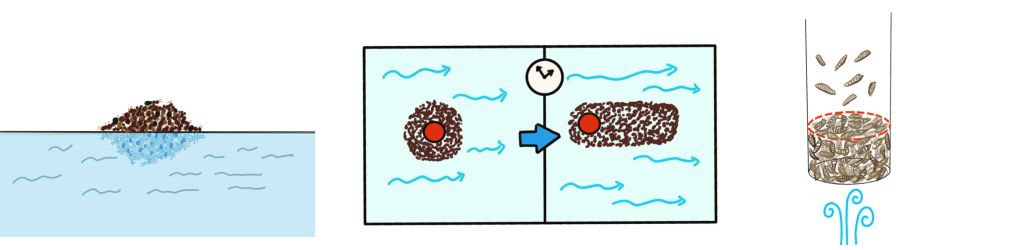
How they form rafts is always a question that puzzles researchers. Fire ants are virtually blind and swim very poorly on the water surface. They can’t see a mate from far away on the water surface and actively congregate. By experimenting with rafts of different sizes, I found something remarkable: small rafts are in fact unstable! Ants are in fact attracted to each other through surface tension, the same mechanism that draws cheerios on the milk surface together. This attraction scales favorably with the number of individual. It is only strong enough to hold a raft together when the raft is large.
- Ko, H., Hadgu, M., Komilian, K., Hu, D.L., 2022, Fire ant rafts are unstable. Physical Review Fluids 7 (9), 090501
Fire Ant Rafts Streamline Under Flow
When fire ant rafts float on the water, they anchor around vegetation. But flow is inevitable. How do they respond collectively to flow? To find out this question, I put rafts in water flow for ten hours. I found that they elongate! They streamline into elliptical shapes which reduces fluid drag. Further analysis showed that through hours of communication among ants, they must know where the anchor for the raft is in order to display this behavior.
- Ko, H., Yu, T., Hu, D.L., 2022. Fire ant rafts elongate under fluid flows. Bioinspiration & Biomimetics 17, no. 4 (June 9, 2022): 045007.

Metabolic Scaling of Ant Collectives
What does “a whole more than the sum of its part” really mean? Would it translate to metabolism? Do larger ant collectives spend less metabolic energy per ants? We put ant collectives in different experimental conditions and measured the carbon dioxide that they produce. We found that when resting, the ants behave as individuals, and the metabolic rate per ant is not affected by the group size. However, when constructing rafts, ants on smaller rafts need to do more work, leading to a higher metabolic rate per capita.

- Ko, H., Komilian, K., Waters, J.S., Hu, D.L, 2021. Metabolic scaling and thermal performance of fire ants (Solenopsis invicta) engaged in collective behaviors. Biology Open (Cover), 11(2), p.bio059076.
Blowing Up Fly Larvae
I know. When you see the title, you must be thinking “why“. While I do have good reasons (see link above), I will just tell you that when I blew up dead larvae, they flew and fell much like how rice grains would (!). What do you think would happen as I blew up live larvae?
- Ko, H., Cassidy, G.J., Shishkov, O., Aydin, E., Hu, D.L, Goldman, D.I., 2021. Air-fluidized aggregates of black soldier fly larvae. Frontiers in Physics, 663.
Dripping Faucet of Ants
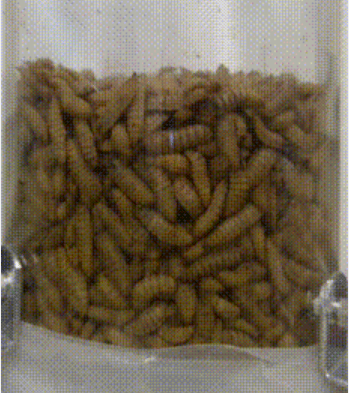
If ants can behave like a fluid, would they drip out from a hole like water? It turns out they do! They in hold together like water droplets! Both phenomena have connections to butterfly effect (chaos), and interesting things happen when you change the flow rate …

Fried rice, C. elegans, traffic flow and more

Physics of Wok-Tossing
Wok-tossing is such a skill! It basically asks the chef to control the trajectories of all the ingredients (rice, vegetables, you name it!), by controlling the movement of the wok. Amateurs like me always mess it up and fail to catch the ingredients. How do they do this so efficiently and effectively?
- Ko, H., Hu, D.L, 2020. The Physics of tossing fried rice. Journal of the Royal Society Interface (Cover), 17: 2019622

Gravity-Sensing in C. elegans and Microfluidic Design
Round worms like C. elegans hare heavier than water. That means that they sink in the water column. One day as I was casually observing how they sink, something remarkable jumped out to me: they almost always orient themselves downwards! Does that mean that they can … sense gravity?
Being denser than water also means that for the most part, they follow the terrain just like terrestrial animals! We can design microfluidic devices, i.e. miniature playground with walls and slides, to force them to go in certain direction, to sort them based on their swimming speed, and to measure their propulsive force.

- Chen, W.*, Ko, H.*, Chuang, H.S., Bau, H.H. Raizen, D.M. 2021. Caenorhabditis elegans Exhibits Positive Gravitaxis. BMC Biology, 19(1), 1-16.
- Yuan, J., Ko, H., Raizen, D.M., Bau, H.H., 2016. Terrain following and applications: Caenorhabditis elegans swims along the floor using a bump and undulate strategy. Journal of the Royal Society Interface, 13(124), p.20160612.
Traffic as a Compressible Fluid
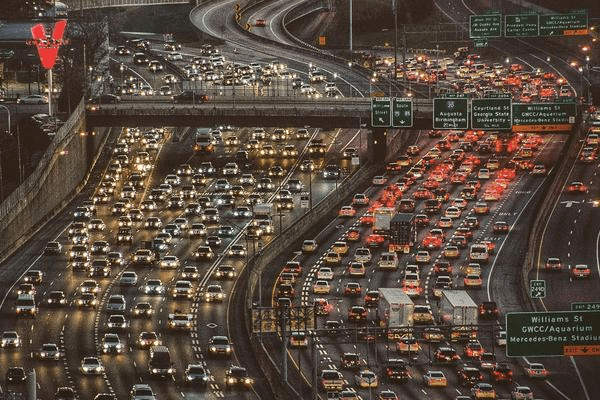
Have you looked at traffic flowing through the highway roads and think they look kind of like gas molecules going through a pipe? I certainly have! It turns out I wasn’t the only one though. Applied mathematicians has had a lot of success apply fluid theories to model traffic flow. My research pushes the analogy a step even further: isn’t cars’ lane-changing behavior a little similar to the viscosity in fluids? Both evens out the speed difference if there’s any! This idea led to my first ever English publication! As it turned out, this was also my well-established Chinese professor’s first ever English publication. He retired a few years later.
- Liu, X., Ko, H., Guo, M., Wu, Z., 2016. A New Traffic Model on Compulsive Lane-Changing Caused by Off-ramp. Chinese Physics B, 25(4), p.048901
- Ko, H., Liu, X., Guo, M., Wu, Z., 2015. A New Traffic Model with a Lane-Changing Viscosity Term. Chinese Physics B, 24(9), p.098901
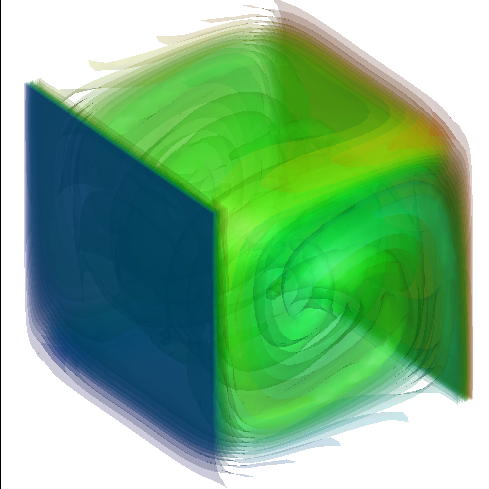
Buoyancy-driven flow is everywhere. When you boil a pot of water, the water at the bottom heats up first before the rest. As a result, it decreases in density (becomes buoyant!) and floats up. The situation is more complex in the ocean where salinity gradient also contributes to density changes. How can we design a high-resolution and high-efficiency fluid simulation platform for these buoyancy-driven flows?
 KOLab @ Tufts